-
Classical
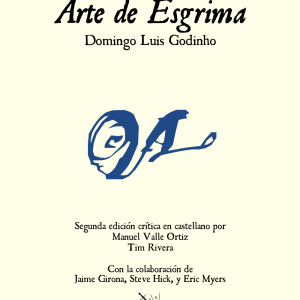
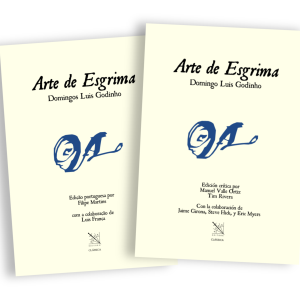
Arte de Esgrima (Spanish) 2nd Edition
25,00 € Add to cart→ After running out of print the first edition, we present this second edition with the correction of errata, some mistakes and the improvement of layout of some pages and the order of chapters. Also you can buy the new Portuguese edition through this link. And the pack of both with savings here.
In 1599, during the period when the Portuguese crown was united to the crowns of Castile and Aragon, a Portuguese master called Domingo Luis Godinho wrote a manuscript in Spanish entitled Arte de Esgrima (The Art of Fencing). The book was never published, and almost nothing is known about its author’s life beyond him being born in Santarém. However, the text is of utmost relevance in the study of Iberian schools of fencing, since it is the single complete treatise discovered so far describing the old style, the one to be displaced by the apogee of Verdadeira Destreza.
The work, originally written in 137 folios that we present as in 291 pages in this current edition, includes instructions for the single sword, sword and rotella, sword and buckler, twin swords, sword and dagger, sword and cape, plus the longest known text on the use of the iberian montante.
-
Classical
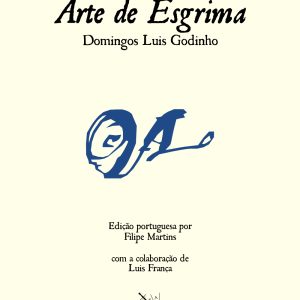
Arte de Esgrima (Portugese)
25,00 € Add to cartThis is the modern Portuguese edition of Domingos Luís Godinho’s Arte de Esgrima, a long-time out of stock classic from the AGEA editora fund that urgently needed to be revised and re-edited.
The Portuguese-language update was carried out by Filipe Martins, from the Academia de Esgrima Histórica, with help from Luís França. Between both, they prepared a modern and accessible version for easy reading, which is preceded by contextualizing antetexts and essays such as the legislation relating to swords in contemporary Portugal, or the role of fencing as an art in the cultural framework of the time.
In 1599, during the period when the Portuguese crown was united to the crowns of Castile and Aragon, a Portuguese master called Domingo Luis Godinho wrote a manuscript in Spanish entitled Arte de Esgrima (The Art of Fencing). The book was never published, and almost nothing is known about its author’s life beyond him being born in Santarém. However, the text is of utmost relevance in the study of Iberian schools of fencing, since it is the single complete treatise discovered so far describing the old style, the one to be displaced by the apogee of Verdadeira Destreza.
The work, originally written in 137 folios that we present as in 230 pages in this current edition, includes instructions for the single sword, sword and rotella, sword and buckler, twin swords, sword and dagger, sword and cape, plus the longest known text on the use of the iberian montante.
-
Classical
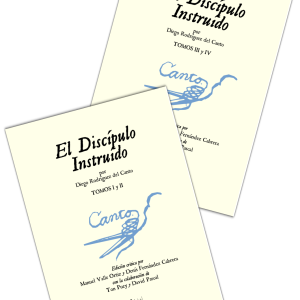
El discípulo instruido y diestro aprovechado en la ciencia filosófica y matemática de la Destreza de las armas (2 volumes)
45,00 € Add to cartA fundamental and, until now, unpublished work of which only one copy exists in a private collection not available to the general public.
Written by D. Diego Rodríguez del Canto, master of arms for the king in the 18th century, this work illustrates the late Verdadera Destreza, its evolution, and the beginning of its decline.
Exceptional among the literature of its genre, this treatise offers through its 434 pages 200 illustrations accompanying each explanation, showing geometric principles up to the decomposition of movement techniques, references for measurements, knowledge trees, etc.
The manual documents how the traditional Destreza adapts to new styles. Rodríguez del Canto created the innovative Doctrina Mixta, incorporating Italian and French techniques. The author cites Pacheco, Ettenhard, and Rada and structures his work into four treatises:
- The first treatise covers philosophical and mathematical principles, applying Arithmetic, Statics, Geometry, Music, and Astronomy; the measures of the weapons (montante, rapier, smallsword, and dagger) and the geometric postures of the three schools: the Iberian, the Italic, and the Gallic.
- The second treatise covers the Destreza categories, body and weapon measurements, lines and figures, the diversity of stances (plantas), steps (compases) and motions, the method of holding the sword, and the diagonal postures.
- The third treatise focuses on the six rules for tretas (Agregación, Atajo, Incluir, Transferir, Formar, and Librar), including the engavilanadas and encadenadas and the smallsword technique.
- The fourth details the use of sword and dagger or sword and cloak, opposition to the left-handed opponent (zurdo), speed drills, and fencing warnings.
Finally, the manual includes a catalog of sword blade manufacturers, with their marks, dated 1734.
-
Contemporary
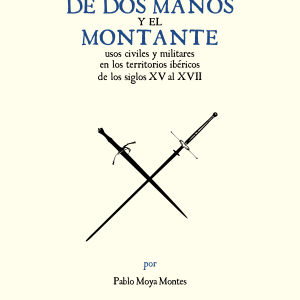
La Espada de Dos Manos y El Montante (2nd ed.)
20,00 € Read moreWithin the «Manuais» editorial line, dedicated to studies, translations and interpretations, we bring this work by Pablo Moya, who has already delighted us with his academic work on Vulgar fencing. This time he breaks down the existing knowledge about two-handed swords and montantes in the Iberian panorama of the early Modern Age.
Given the extent to which he deals with the subject, the limits of an article for a periodical publication are exceeded, so we offered him the possibility to publish a monograph. Once the minimum production costs have been covered, it is our intention to publish openly in order to facilitate its dissemination.
Index (content in Spanish):
- Parte 1: La Espada de dos Manos
- Introducción
- El contexto europeo e ibérico de la espada de dos manos
- La esgrima en la baja edad media ibérica
- Los esgrimidores y la espada de dos manos
- Tratadistas y escritos sobre la esgrima con espada de dos manos
- La espada de dos manos y los gremios de espaderos
- La espada de dos manos en los juegos caballerescos y los desafíos
- La espada de dos manos en la guerra
- La evolución de la espada de dos manos al montante
- Conclusiones
- Parte 2: El Montante
- Introducción
- Los orígenes del montante
- Inicio del uso del montante en los territorios ibéricos
- El montante en la esgrima ibérica
- Tratados y escritos de la esgrima con montante
- El montante en la legislación y el ámbito civil
- Espaderos y montantes
- Santos, bailes y montantes de fuego
- El montante en el arte de la guerra
- El montante en el campo de batalla
- El montante en la guerra de asedio y los combates urbanos
- El montante en la guerra naval
- El ocaso del montante
- Conclusiones
- Referencias bibliográficas
Within the «Manuais» editorial line, dedicated to studies, translations and interpretations, we bring this work by Pablo Moya, who has already delighted us with his academic work on Vulgar fencing. This time he breaks down the existing knowledge about two-handed swords and montantes in the Iberian panorama of the early Modern Age.
Given the extent to which he deals with the subject, the limits of an article for a periodical publication are exceeded, so we offered him the possibility to publish a monograph. Once the minimum production costs have been covered, it is our intention to publish openly in order to facilitate its dissemination.
Index (content in Spanish):
- Parte 1: La Espada de dos Manos
- Introducción
- El contexto europeo e ibérico de la espada de dos manos
- La esgrima en la baja edad media ibérica
- Los esgrimidores y la espada de dos manos
- Tratadistas y escritos sobre la esgrima con espada de dos manos
- La espada de dos manos y los gremios de espaderos
- La espada de dos manos en los juegos caballerescos y los desafíos
- La espada de dos manos en la guerra
- La evolución de la espada de dos manos al montante
- Conclusiones
- Parte 2: El Montante
- Introducción
- Los orígenes del montante
- Inicio del uso del montante en los territorios ibéricos
- El montante en la esgrima ibérica
- Tratados y escritos de la esgrima con montante
- El montante en la legislación y el ámbito civil
- Espaderos y montantes
- Santos, bailes y montantes de fuego
- El montante en el arte de la guerra
- El montante en el campo de batalla
- El montante en la guerra de asedio y los combates urbanos
- El montante en la guerra naval
- El ocaso del montante
- Conclusiones
- Referencias bibliográficas
- Parte 1: La Espada de dos Manos
-
Glossæ
Lessons for the Practice Sword
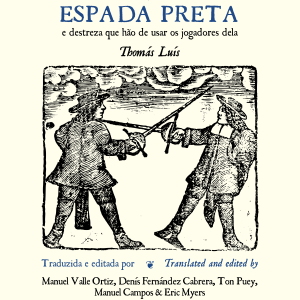
20,00 € Add to cartThis is a second edition of our first published book, Tratado das lições da espada preta, by the late XVII century portuguese master Thomas Luiz. Where the first one was a critical edition, documenting the stemma codicum with its variant sources and setting down the canonical copy, this second edition aims to make this book accessible to a worldwide public by providing an english translation next to the portuguese source.
-
Glossæ
Understanding Destreza
18,00 € Add to cartThis treatise is a delight in briefness, compared to the typical Destreza Specimen. As such, it will be a great introductory text for fencers interested in approaching the literature of the iberian school of swordplay.
For the more experienced theoretical Diestrxs, though, the text offers as well interesting material, since it was written by a man of arms risen in the heart of the orthodox, Pachequist interpretation of Destreza — and yet seems to deviate with Carrancist tones.
Long ignored by the Destreza scholars and nearly unknown by the public, it remained hidden but for an obscure XIX century edition. It is, therefore, with great delight that we bring it to you in a revised transcription of the original text presented side by side with a highly annotated translation into english.
The book includes, as well, cleaned-up versions of the original illustrations, including a spreader page.
-
Agea Presents
A Arte da Esgrima de Joachim Meÿer
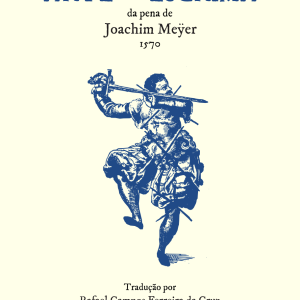
40,00 € Add to cartThe Fundamental Description of the Free, Knightly, and Noble Art of Fencing (1570), by master Joachim Meyer, is widely recognized as the most influential historical fencing treatise in the world. Produced during a period of transition in the Holy Roman Empire, the work represents the masterful systematization of the Germanic combat tradition.
This encyclopedic compendium addresses with profound detail the use of the Longsword, the Dusack, the Rapier, the Dagger, Wrestling (Ringen), and Polearms (Halberd, Pike, and Quarterstaff). In the universe of Historical European Martial Arts (HEMA), the treatise is a cornerstone for modern reconstruction. However, the Portuguese-speaking community faced the barrier of indirect translations that diluted the rich terminology of Early New High German.
This historic edition definitively fills that gap. Translated with philological rigour and deep martial understanding by Rafael Campos Ferreira da Cruz, the work preserves the original mechanics and linguistic signs, keeping the technical terminology intact. Enriched with a vast critical apparatus, notes, and a glossary, this volume brings 16th-century steel back to life, inviting the reader to master essential concepts such as the Vor, the Nach, and the Indes through the pen of master Meyer himself.
-
Classical
Arte de Esgrima (Pack x2 PT+ES)
38,00 € Add to cart→ This is a pack for the joint purchase of the two versions, Portuguese and Spanish, of Arte de Esgrima by Domingo Luis Godinho. Through this product you can buy both copies with a 50% discount on the second.
In 1599, during the period when the Portuguese crown was united to the crowns of Castile and Aragon, a Portuguese master called Domingo Luis Godinho wrote a manuscript in Spanish entitled Arte de Esgrima (The Art of Fencing). The book was never published, and almost nothing is known about its author’s life beyond him being born in Santarém. However, the text is of utmost relevance in the study of Iberian schools of fencing, since it is the single complete treatise discovered so far describing the old style, the one to be displaced by the apogee of Verdadeira Destreza.
The work, originally written in 137 folios that we present as in 230 pages in this current edition, includes instructions for the single sword, sword and rotella, sword and buckler, twin swords, sword and dagger, sword and cape, plus the longest known text on the use of the iberian montante.
-
Classical
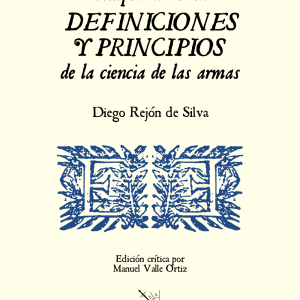
Compendio de las definiciones y principios de la ciencia de las armas
18,00 € Read moreA rare, little known book on 1697 Destreza.A useful assortment of definitions on terminology.A Murcian author who died in Catalonia fighting the Bourbons.The solution to the mystery of the Oviedo M-29 manuscript.All that and much more within the 130 pages of this book by Diego Rejón de Silva, knight from the Order of Calatrava. -
Classical
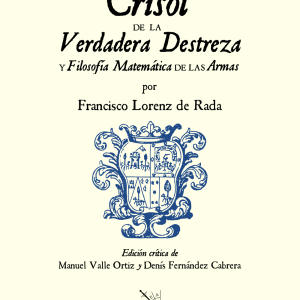
Crisol de la Verdadera Destreza y Filosofía Matemática de las Armas
25,00 € Read moreFrancisco Lorenz de Rada (1660 – 1713) is the last great author — and perhaps the greatest — of the Verdadera Destreza, correcting and elaborating on the works of Carranza, Pacheco and Ettenhard. He was a soldier, a Knight of the Order of Santiago, Governor of Veracruz and, eventually, named Marquis of Torres de Rada. He studied Verdadera Destreza from the age of fourteen and was a fencing master and a prolific and exhaustive author. His magnum opus, Nobleza de la Espada (1705), is a compendium in three books of more than 1,300 pages where he constructs, starting from mathematical and theological elements, a geometric and rationalist system for the use of the rapier.
This work, Crisol, is to a certain extent a precedent of Nobleza, and also a previous stage in the theoretical and practical evolution of its author, in transit from Pachequism to his own expression. There are many parts that are reproduced almost verbatim in Nobleza, but in Crisol a more conventional scheme is followed, similar to other works of Destreza, in which the atajo is described in a generic way (although distinctions are established between one side and the other) and then the Tretas Generales as operating procedures to practice Destreza, ending with a section dedicated to countering Italian fencing (which is notably increased in his great final work).
This edition is of great value, since the only two copies of Crisol that are preserved are incomplete. The text that we present here uses both sources to reconstruct the work as it must have existed.
We have also carefully replicated and (in some cases, following Rada’s own instructions) corrected the 25 diagrams that accompany the text, which we present in our edition as fold-out plates.
Overall, this title is a fundamental piece for any student of Verdadera Destreza, who will hardly find a more exhaustive or precise work in a modern edition.
-
Classical
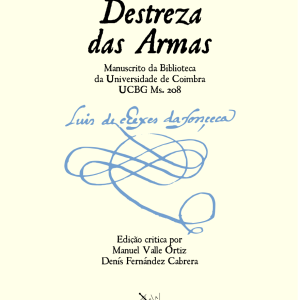
Destreza das Armas
22,00 € Read moreAbout a hundred years ago, a man named Sousa Viterbo –poet, archaeologist, historian, journalist– undertook the major task of writing a portuguese bibliography of fencing books, which he published under the title «A Esgrima em Portugal: Subsídios para a sua História».
While the text gathered all the sources he knew at the moment of publishing, Viterbo kept researching and unearthing new fencing treatises during his life. Many of these findings he noted down in small scraps of paper which he kept between the pages of his own copy of the «Subsídios». We have managed to locate this specific exemplar, and from the notes Viterbo’s left within its pages traced back the whereabouts of the sources not listed within the printed copy.
It is one of these hiterto unpublished manuscripts which we now present: «Destreza das Armas», a compilation of portuguese Destreza translations and original texts.
-
Classical
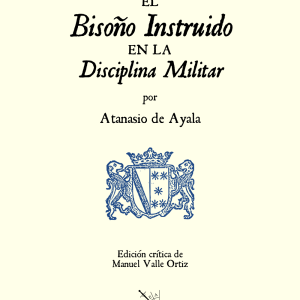
El Bisoño Instruido
20,00 € Add to cartA military treatise from the beginning of the 17th century believed to have been lost. There is a single copy in the Coimbra Library.
We present a critical edition of this work where the author’s military life is recounted, along with advice and experiences to carry out military operations both on land and at sea. It is interesting a section on the handling of the pike and other weapons as well as the ways of fighting at sea and on land, organization of the army, military positions, etc.
In the introduction we include the parts that deal with the handling of the pike in other contemporary treatises, as well as a summary of the abundant military tradition of this time.
-
Classical
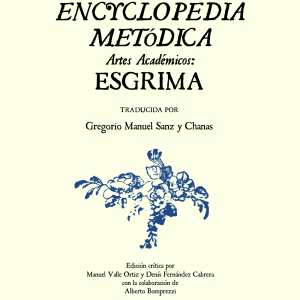
Encyclopedia metódica. Artes académicos. Esgrima.
25,00 € Add to cartThe legendary Encyclopèdie from the French Revolution, translated and adapted into Spanish at the end of the XVIII century.
The text includes the Girard plates from the original publication, reproduced in small size in the spots where they are mentioned, for ease of reference. At the end of the book an appendix holds fold-outs of the plates made for the spanish edition, in faithful reproduction of the original format (about 42×30 cm).
The text itself is preceded by our usual editorial apparatus, and a context-setting essay by Alberto Bomprezzi.
Large format, 21 x 30cm. 100 pages + 11 fold-out 30×40 cm plates.
-
Classical
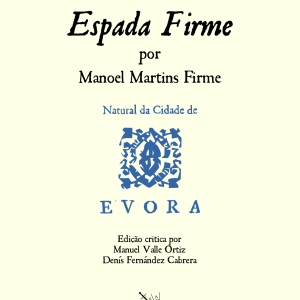
Espada Firme
15,00 € Read moreThe Espada Firme de Manoel Martins Firme is an eighteenth-century transition text in which the rapier is disappearing but the smallsword fencing has not yet completely supplanted it.
A work undoubtedly of interest to anyone studying the eighteenth century or, simply, for anyone who wants to have a complete view of the evolution of fencing in the peninsula throughout history.
-
Agea Presents
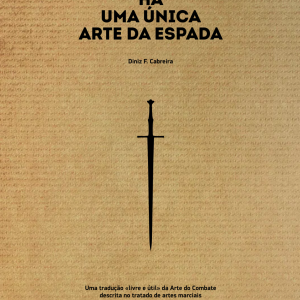
Há Uma Única Arte da Espada (GNM HS 3227a)
20,00 € Add to cartThis is a very liberal Galician-Portuguese translation of the manuscript 3227a from the Germanische Nationalmuseum Nuremberg. It is authored by Diniz Cabreira, director of «Arte do Combate», a galician HEMA school specializing in early Kunst des Fechtens. This edition was created as study material for the school students, but we hope it will be useful to the rest of the portuguese-speaking community. In this regard AGEA Editora is pleased to contribute our editorial resources to facilitate reaching the international public.
-
Classical
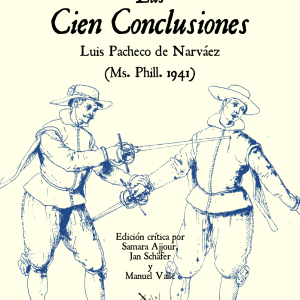
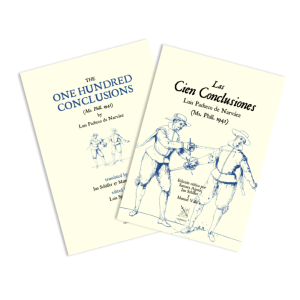
Las Cien Conclusiones (Ms. Phill. 1941)
20,00 € Add to cartThis is a critical edition of the “Berlin Manuscript,” Ms. Phill. 1941, to contain the Cien Conclusiones and the Dieciocho Contradicciones of Luis Pacheco de Narváez. It replaces in our catalog our exhausted first edition of the Cien Conclusiones.
-
Classical
Las cien conclusiones o formas de saber de la verdadera destreza y dieciocho contradicciones a las tretas de la destreza común
14,00 € Read moreThis book is sold out. This edition is superseded by our new edition of Ms. Phill. 1491
This edition includes all known variants of the Cien Conclusiones by Pacheco, (up to twelve sources, including several unpublished manuscripts) and fixes the final text. It includes the history of the original texts, a relationship tree between the different variants and correlation tables numbering the different editions. The illustrations reproduce those from the manuscript of Berlin.
-
Classical
Libro de Armas y Doctrina
20,00 € Add to cartThe anonymous Libro de Armas y Doctrina… is a rare manuscript from the XVIII century containing twelve printed engravings which depicts a transitional period in which Verdadeira Destreza is adapting to the new weapons and customs and struggling not to be replaced by new imported styles.
-
Classical
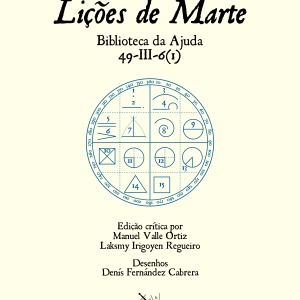
Lições de Marte
22,00 € Read moreThis rare manuscript work, which is kept at the Biblioteca da Ajuda under the key 49 -III- 6, was bound together with the Manuscrito da Espada, also in our catalogue.
It is a re-interpretation of Pacheco's posthumous work, Nueva Ciencia. Beyond completing it with missing information, such as the lost engravings not present in the published version of Pacheco's book, the author took an eminenty practical approach, didactic in purpose, dividing the book in «Lições» (Lessons), each preceded with an illustrative engraving, introducing progressively new concepts, from theoretical geometric elements to steps and footwork, to techniques such as the atalho or the movement of conclussion. This approach makes this book one of the best options when looking for a whole, comprehensive Destreza textbook.
-
Glossæ
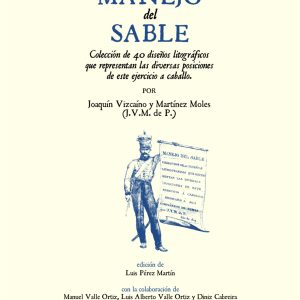
Manejo del sable
35,00 € Add to cartJoaquín Vizcaíno (widowed Marquis of Pontejos) displayed considerable activity, from his beginnings as an officer in the Spanish War of Independence, later as a politician, mayor of Madrid, and founder of the Madrid Savings Bank, without forgetting his artistic inclinations and interest in lithography. The fruit of his diverse occupations is this work, which, through magnificent lithographs, describes the various positions for handling the military saber contained in the Cavalry Regulations of 1815.
In addition to the text of the aforementioned regulations, we have included some commentaries for a better understanding. We also include introductory chapters on weapons, uniforms, and manuals and regulations for the military use of the saber.
Finally, we include a reproduction of the illuminated plates from the copy in the Valle collection. -
Agea Presents
Mano y Media de Fiore dei Liberi
22,00 € Read moreCareful presentation of the art of the sword by master Fiore developed by Manuel Campo, from the Asociación Lucense de Esgrima Antiga. In the book you will find, in addition to the theoretical apparatus necessary to contextualize Art and this interpretation, a step-by-step journey through the techniques of Fior di Batagglia, explained in modern and easy-to-understand terms and accompanied by numerous photographs, with an informal and often humorous tone — an approach that justly earns the subtitle of «Fiore for Dummies».
-
Glossæ
Manuscrito da espada. Biblioteca da Ajuda 49-III-6(2)
20,00 € Add to cartAnonymous work kept at the Livraria de Ajuda under the signature 49 -III- 6, bound in a single volume along with Lições de Marte (also in our catalog). Because this work was the first one in the binding, the set was mistakenly listed as a single text. We therefore face a previously unknown work.
The manuscript presents a vision of fencing in Portugal's seventeenth century, integrating elements of Verdadeira Destreza and the common or «vulgar» tradition. 64 descriptions of feridas (techniques) with their respective counter-techniques. Some of these were previously unknown, such as the Parafusada or the Ferida do Duque de Alva. It also includes comments and glosses.
In order to make the text more accessible, we have translated the original portuguese source into english and spanish; added a glossary and a few reference resources. The language is accessible but a basic knowledge of Verdadeira Destreza is necessary, for which we advice the reader to build upon Mary and Puck Curtis' essay From the Page to the Practice (available as part of In the Service of Mars, vol. II, or elsewhere alone), a brief introduction of Verdadeira Destreza for anglophones.
-
Classical
Modo fácil y nuevo para examinarse los Maestros en la Destreza de las armas y entender sus cien conclusiones
20,00 € Read moreFascinating work that exposes the official Destreza curriculum for most of the seventeenth century, describing the key skills necessary to become an “examined Maestro“. Although it includes the core skills and is quite explicit, it is advised prior knowledge of Destreza or the guide of a Maestro.
Critical edition that reviews the published versions and fixes the text of this treaty.
-
Contemporary
Nueva bibliografía de la antigua esgrima y destreza de las armas
25,00 € Read moreA century after Leguina, an update on Iberian literature. Extensive work of classical literature review with numerous location of funds that had long been “forgotten”. The culmination of a process of data collection through more than ten years. Exhaustive.
-
Classical
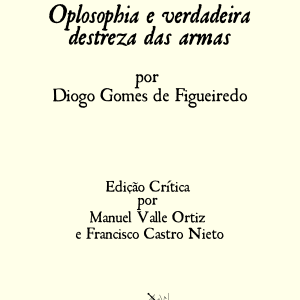
Oplosophia e Verdadeira Destreza das Armas
25,00 € Read moreWritten by Diogo Gomes de Figueiredo, author of the shorter «Memorial da Práctica do Montante», in 1628, the book develops along more than 300 pages notes on the Verdadeira Destreza approach to single rapier and rapier with dagger, buckler, rotella, armguard, gauntlet and cape, as well as presenting a view on twin rapier play; how men of different sizes should fence; theory and advice ond stepping and wounding; notes on how to distinguish true («Verdadeira») from false Destreza; particularly tricky questions regarding «Verdadeira Destreza» for the Masters to use in their examinations and how to carry these; how Masters should use a staff to separate the opponents in a fencing bout; what are the differences between live and blunt weapons in fencing… Everything seasoned with not a small gathering of sonnets and diverse poems.
The critical work carried by the AGEA Editora team for this book, comprising this time Manuel Valle Ortiz and Francisco Castro Nieto, adds another hundred pages to the volume: extensive annotations as both footnotes and endnotes to the text, introductory small essays on the linguistic, military and librarian aspects of the book, consolidated criteria regarding the transcription as well as an extensive bibliography citing the references the original author used.
-
Classical
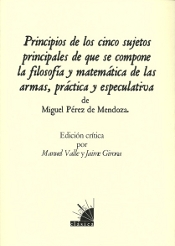
Principios de los cinco sujetos principales de que se compone la filosofía y matemática de las armas, práctica y especulativa
20,00 € Read moreA rare but interesting work: an introductory manual to Destreza which can be considered intermediate between Pacheco and Ettenhard. Perez de Mendoza is somewhat unorthodox, but basically belongs in the Pacheco school, especially in this book. Very interesting interpretations of the Vulgar tricks, different from those of Pacheco and Cruzado.
-
Glossæ
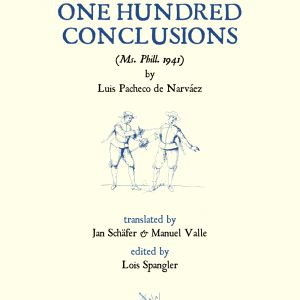
The One Hundred Conclusions (Ms. Phill. 1941)
20,00 € Add to cartThis is an English translation of the «Berlin Manuscript», Ms. Phil. 1941, containing the Cien Conclusiones («One Hundred Conclusions») and the Dieciocho Contradicciones («Eighteen Oppositions») by Luis Pacheco de Narváez, as well as various other texts and images. The translation was carried out by Jan Schäfer and Manuel Valle Ortiz, and supervised by Lois Spangler.
-
Classical
The One Hundred Conclusions (Pack x2 EN+ES)
30,00 € Add to cart→ This is a pack for purchasing both versions together, Spanish and English, of the Cien Conclusiones by Luis Pacheco de Narváez. Through this product you can buy both copies with a 50% discount on the second.
In addition to the «Conclusiones» and the «Contradicciones», the book includes a section describing the techniques typical of Verdadeira Destreza, a series of definitions of terms in the form of a question-answer dialogue, and an explanation with illustrations of the steps, the lines of the body, the right angle, the «medio proporcionado», the execution of the «atajo» and the movement of conclusion.
This carefully crafted work is a fundamental text both for those who already are into Verdadeira Destreza, and for those who are starting to study it.
-
Classical
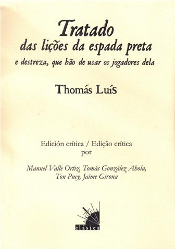
Tratado das lições da espada preta
5,00 € Read moreSold out. You can buy the second edition (with english translation) instead.
This small piece shows a view of late XVII century portuguese fencing which, although sharing characteristics with the Verdadera Destreza, follows its own path.
Critical edition which includes all the known versions of this rare treatise.