Uncategorized
Showing all 9 results
-
Uncategorized
Arte de Esgrima (Portugese)
25,00 € Add to cartThis is the modern Portuguese edition of Domingos Luís Godinho’s Arte de Esgrima, a long-time out of stock classic from the AGEA editora fund that urgently needed to be revised and re-edited.
The Portuguese-language update was carried out by Filipe Martins, from the Academia de Esgrima Histórica, with help from Luís França. Between both, they prepared a modern and accessible version for easy reading, which is preceded by contextualizing antetexts and essays such as the legislation relating to swords in contemporary Portugal, or the role of fencing as an art in the cultural framework of the time.
In 1599, during the period when the Portuguese crown was united to the crowns of Castile and Aragon, a Portuguese master called Domingo Luis Godinho wrote a manuscript in Spanish entitled Arte de Esgrima (The Art of Fencing). The book was never published, and almost nothing is known about its author’s life beyond him being born in Santarém. However, the text is of utmost relevance in the study of Iberian schools of fencing, since it is the single complete treatise discovered so far describing the old style, the one to be displaced by the apogee of Verdadeira Destreza.
The work, originally written in 137 folios that we present as in 230 pages in this current edition, includes instructions for the single sword, sword and rotella, sword and buckler, twin swords, sword and dagger, sword and cape, plus the longest known text on the use of the iberian montante.
-
Uncategorized
Arte de Esgrima (Spanish) 2nd Edition
25,00 € Add to cart→ After running out of print the first edition, we present this second edition with the correction of errata, some mistakes and the improvement of layout of some pages and the order of chapters. Also you can buy the new Portuguese edition through this link. And the pack of both with savings here.
In 1599, during the period when the Portuguese crown was united to the crowns of Castile and Aragon, a Portuguese master called Domingo Luis Godinho wrote a manuscript in Spanish entitled Arte de Esgrima (The Art of Fencing). The book was never published, and almost nothing is known about its author’s life beyond him being born in Santarém. However, the text is of utmost relevance in the study of Iberian schools of fencing, since it is the single complete treatise discovered so far describing the old style, the one to be displaced by the apogee of Verdadeira Destreza.
The work, originally written in 137 folios that we present as in 291 pages in this current edition, includes instructions for the single sword, sword and rotella, sword and buckler, twin swords, sword and dagger, sword and cape, plus the longest known text on the use of the iberian montante.
-
Uncategorized
Espada Firme
15,00 € Read moreThe Espada Firme de Manoel Martins Firme is an eighteenth-century transition text in which the rapier is disappearing but the smallsword fencing has not yet completely supplanted it.
A work undoubtedly of interest to anyone studying the eighteenth century or, simply, for anyone who wants to have a complete view of the evolution of fencing in the peninsula throughout history.
-
Uncategorized
Há Uma Única Arte da Espada (GNM HS 3227a)
20,00 € Add to cartThis is a very liberal Galician-Portuguese translation of the manuscript 3227a from the Germanische Nationalmuseum Nuremberg. It is authored by Diniz Cabreira, director of «Arte do Combate», a galician HEMA school specializing in early Kunst des Fechtens. This edition was created as study material for the school students, but we hope it will be useful to the rest of the portuguese-speaking community. In this regard AGEA Editora is pleased to contribute our editorial resources to facilitate reaching the international public.
-
Uncategorized
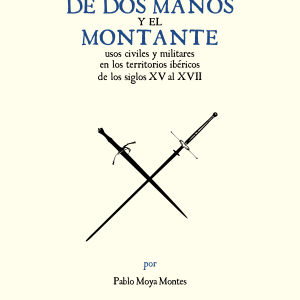
La Espada de Dos Manos y El Montante (2nd ed.)
20,00 € Read moreWithin the «Manuais» editorial line, dedicated to studies, translations and interpretations, we bring this work by Pablo Moya, who has already delighted us with his academic work on Vulgar fencing. This time he breaks down the existing knowledge about two-handed swords and montantes in the Iberian panorama of the early Modern Age.
Given the extent to which he deals with the subject, the limits of an article for a periodical publication are exceeded, so we offered him the possibility to publish a monograph. Once the minimum production costs have been covered, it is our intention to publish openly in order to facilitate its dissemination.
Index (content in Spanish):
- Parte 1: La Espada de dos Manos
- Introducción
- El contexto europeo e ibérico de la espada de dos manos
- La esgrima en la baja edad media ibérica
- Los esgrimidores y la espada de dos manos
- Tratadistas y escritos sobre la esgrima con espada de dos manos
- La espada de dos manos y los gremios de espaderos
- La espada de dos manos en los juegos caballerescos y los desafíos
- La espada de dos manos en la guerra
- La evolución de la espada de dos manos al montante
- Conclusiones
- Parte 2: El Montante
- Introducción
- Los orígenes del montante
- Inicio del uso del montante en los territorios ibéricos
- El montante en la esgrima ibérica
- Tratados y escritos de la esgrima con montante
- El montante en la legislación y el ámbito civil
- Espaderos y montantes
- Santos, bailes y montantes de fuego
- El montante en el arte de la guerra
- El montante en el campo de batalla
- El montante en la guerra de asedio y los combates urbanos
- El montante en la guerra naval
- El ocaso del montante
- Conclusiones
- Referencias bibliográficas
Within the «Manuais» editorial line, dedicated to studies, translations and interpretations, we bring this work by Pablo Moya, who has already delighted us with his academic work on Vulgar fencing. This time he breaks down the existing knowledge about two-handed swords and montantes in the Iberian panorama of the early Modern Age.
Given the extent to which he deals with the subject, the limits of an article for a periodical publication are exceeded, so we offered him the possibility to publish a monograph. Once the minimum production costs have been covered, it is our intention to publish openly in order to facilitate its dissemination.
Index (content in Spanish):
- Parte 1: La Espada de dos Manos
- Introducción
- El contexto europeo e ibérico de la espada de dos manos
- La esgrima en la baja edad media ibérica
- Los esgrimidores y la espada de dos manos
- Tratadistas y escritos sobre la esgrima con espada de dos manos
- La espada de dos manos y los gremios de espaderos
- La espada de dos manos en los juegos caballerescos y los desafíos
- La espada de dos manos en la guerra
- La evolución de la espada de dos manos al montante
- Conclusiones
- Parte 2: El Montante
- Introducción
- Los orígenes del montante
- Inicio del uso del montante en los territorios ibéricos
- El montante en la esgrima ibérica
- Tratados y escritos de la esgrima con montante
- El montante en la legislación y el ámbito civil
- Espaderos y montantes
- Santos, bailes y montantes de fuego
- El montante en el arte de la guerra
- El montante en el campo de batalla
- El montante en la guerra de asedio y los combates urbanos
- El montante en la guerra naval
- El ocaso del montante
- Conclusiones
- Referencias bibliográficas
- Parte 1: La Espada de dos Manos
-
Uncategorized
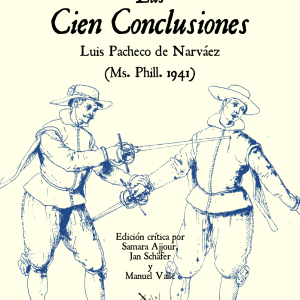
Las Cien Conclusiones (Ms. Phill. 1941)
20,00 € Add to cartThis is a critical edition of the “Berlin Manuscript,” Ms. Phill. 1941, to contain the Cien Conclusiones and the Dieciocho Contradicciones of Luis Pacheco de Narváez. It replaces in our catalog our exhausted first edition of the Cien Conclusiones.
-
Uncategorized
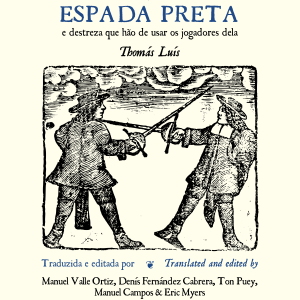
Lessons for the Practice Sword
20,00 € Add to cartThis is a second edition of our first published book, Tratado das lições da espada preta, by the late XVII century portuguese master Thomas Luiz. Where the first one was a critical edition, documenting the stemma codicum with its variant sources and setting down the canonical copy, this second edition aims to make this book accessible to a worldwide public by providing an english translation next to the portuguese source.
-
Uncategorized
Libro de Armas y Doctrina
20,00 € Add to cartThe anonymous Libro de Armas y Doctrina… is a rare manuscript from the XVIII century containing twelve printed engravings which depicts a transitional period in which Verdadeira Destreza is adapting to the new weapons and customs and struggling not to be replaced by new imported styles.
-
Uncategorized
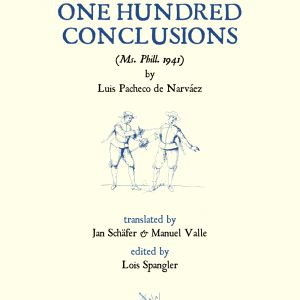
The One Hundred Conclusions (Ms. Phill. 1941)
20,00 € Add to cartThis is an English translation of the «Berlin Manuscript», Ms. Phil. 1941, containing the Cien Conclusiones («One Hundred Conclusions») and the Dieciocho Contradicciones («Eighteen Oppositions») by Luis Pacheco de Narváez, as well as various other texts and images. The translation was carried out by Jan Schäfer and Manuel Valle Ortiz, and supervised by Lois Spangler.